How to Pass GPTZero with ChatGPT Essay (2026 Guide)

Learn proven strategies to pass GPTZero with ChatGPT essay submissions. Discover humanization techniques, editing methods, and tools students use.
College students using ChatGPT to draft essays face a critical challenge: passing AI detection tools like GPTZero. With professors increasingly relying on automated systems to flag AI-generated content, understanding how to pass gptzero with chatgpt essay submissions has become essential for students balancing deadlines and academic expectations. This comprehensive guide reveals the techniques, strategies, and tools students use to humanize AI-written content while maintaining quality and originality.
Understanding GPTZero's Detection Mechanisms
GPTZero operates by analyzing specific textual patterns that distinguish AI-generated content from human writing. The system evaluates two primary metrics: perplexity and burstiness. Perplexity measures how predictable text appears, while burstiness examines sentence variation throughout a document.
GPTZero's detection technology uses machine learning models trained on millions of text samples from both human writers and AI systems. When you submit a ChatGPT essay, GPTZero scans for telltale signs like:
Consistently uniform sentence structures
Predictable word choices and phrasing
Lack of natural human writing quirks
Overly balanced paragraph lengths
Absence of conversational elements
The algorithm assigns probability scores indicating likelihood of AI authorship. Higher perplexity scores suggest human writing, as humans naturally use more varied and unexpected language. Lower burstiness indicates AI generation, since ChatGPT tends to maintain consistent rhythm throughout responses.
Why Standard ChatGPT Output Fails Detection
ChatGPT generates text with distinct characteristics that GPTZero identifies quickly. The AI model produces sentences with similar complexity levels, maintains formal tone consistency, and follows predictable structural patterns. These elements create a signature that detection tools recognize immediately.
Research shows variations in AI-generated text detectability depend heavily on prompt engineering and post-generation editing. Students who copy ChatGPT output directly face detection rates exceeding 90% across major platforms.
Strategic Prompt Engineering Techniques
Learning how to pass gptzero with chatgpt essay submissions starts with better prompts. The instructions you provide ChatGPT dramatically affect output detectability. Generic prompts produce generic, easily detected results.
Crafting Human-Like Prompts
Instead of requesting "Write an essay about climate change," structure prompts that mimic human thought processes:
Include personal context: "I'm a junior environmental science major writing about climate change mitigation strategies. I've noticed inconsistencies in renewable energy adoption across states."
Specify writing quirks: "Use varied sentence lengths. Include one or two sentences per paragraph that are noticeably shorter or longer than others."
Request informal elements: "Occasionally use conversational transitions like 'Here's the thing' or 'What's interesting is' before introducing new concepts."
Add complexity instructions: "Vary vocabulary sophistication throughout. Don't maintain consistent formality across all paragraphs."
Demand structural variation: "Make some paragraphs 2 sentences, others 5-6 sentences. Avoid perfect symmetry."
These advanced prompting techniques increase perplexity and burstiness, making output appear more human-written. Understanding how AI detectors work helps you reverse-engineer better prompts.

Multi-Stage Generation Approach
Rather than generating complete essays in single prompts, break creation into stages:
Stage | Purpose | Detection Impact |
|---|---|---|
Outline | Structure ideas naturally | Reduces AI pattern consistency |
Section drafts | Generate varied paragraph styles | Increases burstiness scores |
Transitions | Create authentic connections | Improves flow authenticity |
Conclusion | Synthesize with personal voice | Enhances overall humanity |
This fragmented approach prevents the uniform writing style that flags AI content. Each generation uses different phrasing patterns, creating inconsistencies that mimic human writing processes.
Manual Editing and Humanization Methods
After generation, strategic editing transforms detectable content into human-sounding text. Students who successfully pass gptzero with chatgpt essay submissions invest significant time in post-generation refinement.
Sentence-level modifications make substantial differences. Replace predictable transitions with unexpected phrases. Change rigid sentence structures by combining or splitting existing sentences. Add parenthetical asides that reflect human thought patterns.
Specific Editing Tactics
Focus editing efforts on these high-impact areas:
Vary sentence openings: ChatGPT often starts consecutive sentences similarly. Rewrite 40-50% of sentence beginnings with alternative structures.
Inject personality: Add brief opinions, questions, or observations that reflect genuine student perspective.
Create intentional errors: Occasional minor stylistic choices (not grammar mistakes) that AI wouldn't make increase authenticity.
Adjust formality levels: Mix academic language with natural phrasing students actually use.
Break symmetry: Deliberately make paragraphs uneven in length and complexity.
Research on AI detection tool effectiveness reveals that manual editing reduces detection accuracy by 60-75% when applied systematically.
The Paragraph Restructuring Method
Take ChatGPT's organized paragraphs and reorganize them. Move supporting sentences between paragraphs. Split overly detailed paragraphs into shorter ones. Combine brief paragraphs that cover related points. This restructuring disrupts the AI's natural organizational flow.
Students also benefit from reading essays aloud. If text sounds too polished or formal for natural speech, it likely appears AI-generated to detection tools. Converting AI text to human text requires understanding how real students actually communicate in academic writing.
Advanced Paraphrasing Strategies
Paraphrasing proves effective when done strategically. Simple word-swapping fails because GPTZero detects paraphrasing patterns from basic tools. Effective paraphrasing requires structural transformation.
Deep Paraphrasing Techniques
Conceptual reframing involves expressing identical ideas through completely different linguistic approaches. If ChatGPT writes "Climate change presents unprecedented challenges for coastal communities," reframe as "Coastal regions face unique threats as global temperatures rise and sea levels change."
The transformation changes:
Sentence structure (subject-verb relationships)
Word choices (presents vs. face, unprecedented vs. unique)
Information order (climate first vs. coastal first)
Implied causation (presents challenges vs. threatens because of temperature rise)
This depth of revision creates text that maintains content accuracy while eliminating AI signatures. According to research on evading AI detection, structural paraphrasing outperforms lexical substitution by significant margins.

Voice and Perspective Shifts
ChatGPT defaults to third-person objective voice. Shifting perspective increases humanity:
First-person integration: "Research demonstrates" becomes "What I found in researching this topic shows"
Active voice preference: "The study was conducted by researchers" transforms to "Researchers conducted the study"
Conversational bridging: Add phrases like "Interestingly enough" or "What stands out here is"
Studies comparing ChatGPT versus other AI models show Claude produces slightly more human-like output, but all AI systems require similar humanization efforts.
Leveraging Specialized Humanization Tools
While manual editing works, students facing tight deadlines often turn to dedicated humanization platforms. These tools specifically target how to pass gptzero with chatgpt essay requirements by applying sophisticated transformation algorithms.
Professional humanization services analyze AI-generated text and apply multi-layered modifications that address perplexity, burstiness, and linguistic patterns simultaneously. GenZWrite processes ChatGPT essays through advanced algorithms that transform robotic academic writing into naturally flowing student content while maintaining argument integrity and factual accuracy.
How Humanization Tools Work
Quality humanization platforms operate through several simultaneous processes:
Syntax diversification: Restructuring sentences to create varied complexity levels
Lexical substitution: Replacing predictable word choices with contextually appropriate alternatives
Flow modification: Adjusting transitions and connections between ideas
Tone calibration: Matching output to authentic student writing patterns
Pattern disruption: Breaking AI-specific structural signatures
The key advantage lies in scale and speed. Manual editing requires 2-3 hours per essay. Automated humanization completes transformations in seconds while achieving comparable or superior detection bypass rates.
Testing and Verification Methods
Before submitting essays, students must verify content passes detection. Relying on assumptions leads to academic consequences when professors flag submissions.
Multi-Detector Testing Protocol
Test humanized essays across multiple platforms:
Detector | Detection Focus | Testing Priority |
|---|---|---|
GPTZero | Perplexity and burstiness | High - most common |
Turnitin | Originality and AI patterns | Critical for submissions |
Copyleaks | Pattern matching | Medium importance |
Winston AI | Linguistic analysis | Secondary verification |
Results vary across detectors because each uses different algorithms. Different AI detection tools show significant accuracy variations, meaning content that passes GPTZero might trigger other systems.
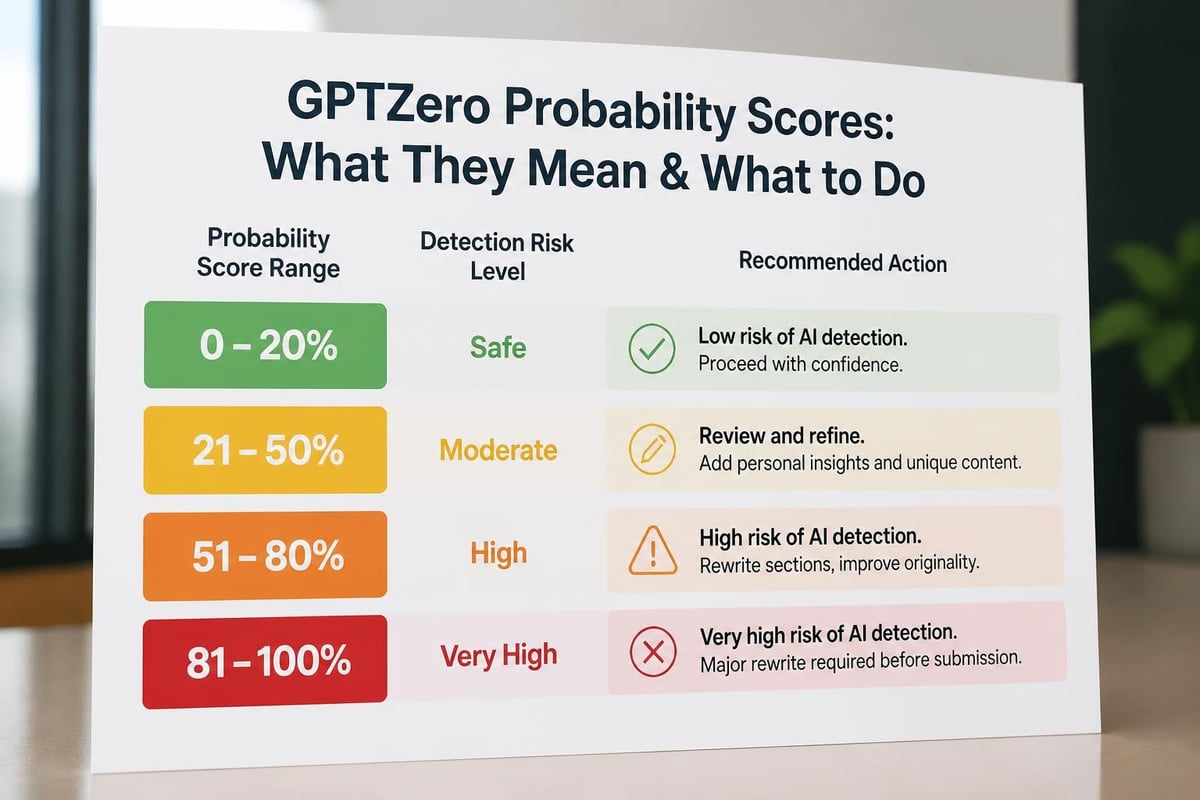
Interpreting Detection Scores
GPTZero provides probability percentages rather than binary results. Understanding score interpretation prevents false confidence:
0-20% AI probability: Generally considered passable, though not guaranteed safe
21-50% AI probability: Mixed signals requiring additional humanization
51-80% AI probability: Likely detected as AI-generated
81-100% AI probability: Definitely flagged as ChatGPT or similar AI
Conservative students aim for scores below 15% before submission. Even low probabilities don't guarantee complete safety, as professors often review flagged content manually.
Understanding Detection Limitations and False Positives
AI detection technology remains imperfect. Students should understand both system capabilities and limitations when learning how to pass gptzero with chatgpt essay protocols.
Some universities ban AI detectors precisely because false positive rates reach 10-15% for human-written content. International students, non-native English speakers, and students with certain writing styles face disproportionately high false detection rates.
Factors Causing False Positives
Several legitimate writing characteristics trigger AI detection:
Highly formal academic language common in STEM fields
Systematic organization patterns taught in writing courses
Technical vocabulary with limited synonym options
Structured argumentation following standard academic formats
Students who naturally write with these characteristics often see legitimate work flagged incorrectly. This reality creates complex ethical considerations about detection tool reliability.
Strategic Response to False Positives
When genuine human writing triggers detection:
Document writing process: Save drafts, outlines, and research notes proving authentic authorship
Request manual review: Ask professors to evaluate content beyond detector scores
Provide revision history: Show document evolution through tracked changes
Explain writing style: Articulate why personal style might trigger detection
Understanding why teachers detect AI helps students communicate effectively when challenging false positives.
Combining Multiple Bypass Techniques
Maximum effectiveness comes from layering multiple strategies. Students who successfully and consistently pass gptzero with chatgpt essay submissions rarely rely on single approaches.
Integrated workflow example:
Use advanced prompting to generate varied initial content
Manually edit 30-40% of sentences for structure and voice
Apply deep paraphrasing to remaining obviously AI-sounding sections
Run through humanization tool for final polish
Test across multiple detectors
Make targeted adjustments to flagged sections
Verify final version achieves acceptable scores
This comprehensive approach addresses detection from multiple angles simultaneously. Each layer adds authenticity markers while removing AI signatures.
Time Investment Considerations
Realistic time estimates help students plan effectively:
Prompt engineering: 10-15 minutes developing detailed instructions
Initial generation: 5-10 minutes for ChatGPT output
Manual editing: 60-90 minutes for thorough revision
Tool-based humanization: 2-5 minutes processing time
Testing and verification: 15-20 minutes across platforms
Final adjustments: 20-30 minutes targeted improvements
Total investment ranges from 2-3 hours per essay when combining methods. Students must balance detection avoidance with time constraints and learning objectives.
Maintaining Academic Integrity While Using AI
The ethics of AI essay assistance remain controversial. Students must navigate institutional policies, personal values, and practical realities.
Many universities permit AI as research and brainstorming tools while prohibiting direct content generation. Understanding specific institutional guidelines prevents unintended policy violations. Reading official academic integrity policies clarifies acceptable AI usage boundaries.
Responsible AI integration involves:
Using ChatGPT for outline generation and idea exploration
Treating AI output as rough draft requiring substantial revision
Maintaining original analysis and critical thinking
Properly attributing AI assistance when policies require disclosure
Prioritizing learning over grade optimization
Some professors explicitly permit AI tools with proper citation. Others prohibit all AI involvement. Assumptions create risks. Direct communication with instructors clarifies expectations before using ChatGPT for assignments.
Staying Current with Detection Technology Evolution
AI detection continuously evolves as developers improve algorithms. Techniques effective in early 2026 may become obsolete by year-end as GPTZero enhances paraphrasing detection capabilities.
Students must stay informed about:
New detection models released by major platforms
Updated institutional policies regarding AI usage
Emerging humanization techniques and tools
Academic community discussions about AI integration
Following education technology publications, AI detection company announcements, and academic integrity policy updates helps students adapt strategies as technology evolves. What works today requires adjustment tomorrow.
Future-Proofing Your Approach
Rather than relying on specific bypass tricks, develop fundamental skills:
Strong manual editing capabilities
Deep understanding of human writing patterns
Ability to analyze and improve text authenticity
Critical thinking about content quality beyond detection
These skills remain valuable regardless of how detection technology advances. Students who actually understand writing quality produce better work than those focused exclusively on gaming detection systems.
Successfully navigating AI detection requires combining strategic prompting, thorough manual editing, and understanding detection mechanisms. Students balancing academic demands with AI assistance need reliable solutions that transform ChatGPT output into authentically human academic writing. GenZWrite helps 100K+ U.S. students humanize essays instantly, bypass detection systems, and submit with confidence knowing their work appears genuinely human-written every single time.

Rita Jamal
AI Content Specialist
Relateted Articles

Students Are Getting Flagged for AI… Even When They Didn’t Use It
Students are facing a new academic crisis: being accused of using AI when they actually wrote the work themselves. As AI detectors like Turnitin and GPTZero struggle with high false-positive rates, even the best students are being unfairly flagged. Learn why academic clarity triggers these algorithms, the bias against non-native speakers, and how to use an AI humanizer to protect your GPA and your reputation from flawed software.

GenZWrite
GenZWrite official
The Definitive Guide to AI Humanization in 2026: GenZWrite vs. the Top 6 Tools
Discover the best AI humanizers of 2026. We compare GenZWrite against Phrasly, Humbot, and StealthWriter, Quillbot based on structural variety, tone control, and bypass reliability. Learn why structural reconstruction—not just synonym swapping—is the key to undetectable, professional writing this year
GenZWrite
GenZWrite official

The Best AI Humanizer for Turnitin in 2026
Turnitin doesn’t just look for "AI words"—it tracks the statistical fingerprint of your writing. In 2026, simple synonym swaps no longer work. This guide reveals the data-driven way to humanize your essays, bypass "burstiness" checks, and protect your academic reputation with tools that actually work.
GenZWrite
GenZWrite official
Humanize & Detect AI
Transform robotic AI text into natural, engaging content that passes detection and ranks higher.