Does ChatGPT or Claude Write More Like a Human in 2026? The Truth About AI Detectors
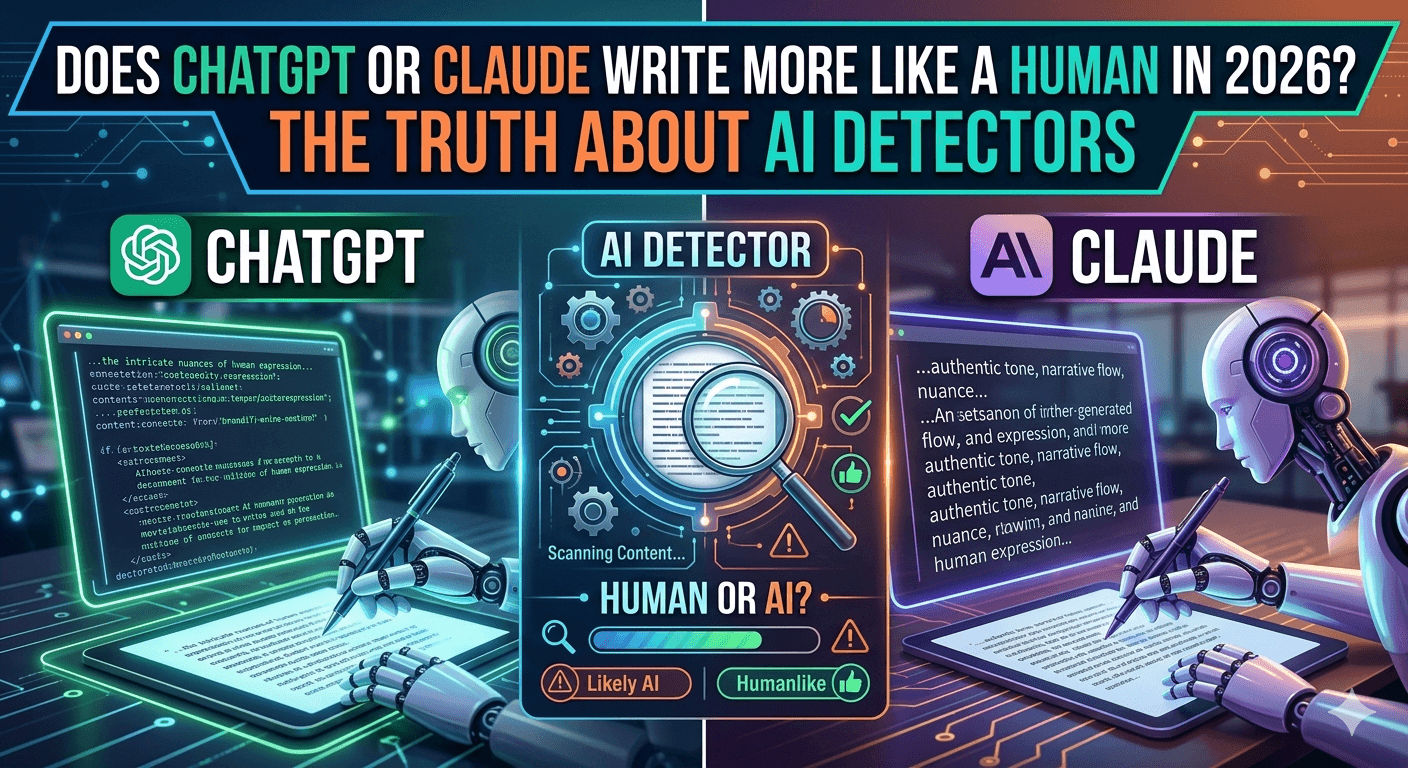
In 2026, AI detectors are sharper than ever — and both ChatGPT and Claude can still get flagged. This guide breaks down which LLM produces more human-sounding writing, what AI detectors are really scanning for, and why pairing your AI with a quality AI humanizer tool is the smartest move for writers, students, and families.
Every writer, student, marketer, and content creator is asking the same two questions right now: Which AI writes more like a human, ChatGPT or Claude? And more urgently will an AI detector catch it?
In 2026, those aren't hypothetical questions anymore. AI detectors have grown sharper, schools are scanning every submitted essay, and businesses are flagging AI-generated content before it ever reaches a client. The pressure is real. And the answer to both questions is more nuanced than most comparison articles want to admit.
This guide breaks down exactly how ChatGPT and Claude perform when it comes to human-sounding output, what the best AI detectors are actually looking for, and why smart writers are now pairing their favorite LLM with an AI humanizer tool to get content that's genuinely undetectable, polished, and penalty-free.
ChatGPT vs. Claude: Which One Sounds More Human?
Let's address the most searched question head-on. Both ChatGPT and Claude have dramatically improved their writing quality in 2026, but they have fundamentally different tones and those differences matter when an AI detector is scanning your work.
Claude consistently produces prose that reads more naturally and conversationally. It avoids the telltale patterns that AI detectors love to flag: the overuse of transitional phrases like "It's important to note," the robotic "In conclusion" closing, and the stiff, essay-like structure that screams machine-generated. Claude tends to ask itself clarifying questions about your request before writing, which results in content that's more context-aware and layered.
ChatGPT, especially with GPT-5.2, is faster and more obedient it does exactly what you ask without pushback. That's a strength for brainstorming and rapid ideation. However, speed comes with a cost: ChatGPT's default output style is slightly more formulaic, which makes it marginally easier for sophisticated AI detectors to flag, especially on longer pieces like essays, blog posts, or reports.
In independent 2026 benchmarks, Claude scored around 95% functional accuracy on writing tasks compared to ChatGPT's 85%, and multiple writing evaluations noted that Claude produced more coherent long-form content scoring higher on structure and tone consistency. For writers who care about sounding human first, Claude holds a slight edge.
But here's the truth neither model's fanbase wants to admit: both ChatGPT and Claude can still be caught by a good AI detector. The gap between them is narrowing, and neither is a guaranteed pass on its own.
What Are AI Detectors Actually Looking For in 2026?
Understanding AI detectors is no longer optional if you're creating content at scale. Tools like Turnitin, Copyleaks, GPTZero, and Winston AI have evolved significantly. They're no longer just scanning for keyword repetition they're analyzing:
- Perplexity how surprising or unpredictable the word choices are (human writing is messier and less "optimal")
- Burstiness humans vary their sentence lengths dramatically; AI tends to keep them uniform
- Sentence rhythm AI tends to produce evenly paced text; natural human writing has irregular beats
- Structural predictability AI almost always organizes thoughts in a clean, logical flow; humans are less tidy
The problem? When you ask Claude or ChatGPT to "write like a human," they still optimize for clarity and correctness because that's what they were trained to do. They'll tone down the obvious tells, but they won't fully replicate the beautiful messiness of genuine human expression.
This is exactly the gap that AI humanizer tools were built to close.
Why Every AI Writer Needs an AI Humanizer Tool in 2026
An AI humanizer doesn't replace your AI model it works alongside it. You use Claude or ChatGPT to generate a solid draft, then run it through an AI humanizer to reshape sentence structure, inject natural rhythm variation, introduce unpredictability in word choice, and strip away the mechanical patterns that detectors target.
The best AI humanizer tools in 2026 do this without gutting the meaning, tone, or accuracy of your original content. You get the speed and intelligence of a large language model plus writing that passes even the most aggressive AI detector scan.
If you've been looking for a reliable solution, GenzWrite's AI Humanizer is one of the most effective tools available right now. It's built specifically to rewrite AI-generated content in a way that mimics natural human writing patterns not by spinning words randomly, but by restructuring the prose intelligently. Whether you're a student submitting coursework, a freelancer delivering client copy, or a content team publishing at scale, it's a workflow upgrade you'll wonder how you lived without.
The AI Humanizer for Families: A Real Use Case Nobody Talks About
Most conversations about AI humanizer tools focus on professionals and students. But here's a growing use case: families using AI tools together.
Parents helping kids with school projects, homeschool families using AI to generate study materials, or parents writing newsletters for community groups all of them face the same AI detection risk if their content looks machine-generated. A family-friendly AI humanizer bridges the gap between "AI helped us write this" and content that feels personal, warm, and authentic.
The key features to look for in an AI humanizer for family and personal use:
- Simple interface no technical knowledge required
- Tone control ability to shift from formal to casual depending on the context
- Speed gets the job done without a steep learning curve
- Safety no storing of sensitive content submitted through the tool
An AI humanizer isn't just for SEO writers and marketers anymore. It's become a household writing tool.
Long-Tail Keywords That Tell You What People Really Need
The search terms people are typing in 2026 tell a clear story about what the market actually wants:
- "best free AI humanizer to bypass AI detector"
- "AI humanizer undetectable for students"
- "how to make ChatGPT writing undetectable"
- "does Claude bypass AI detectors"
- "AI humanizer for essays no plagiarism"
- "family-friendly AI humanizer tool"
- "AI content rewriter that passes Turnitin"
Every one of these searches points to the same pain point: people are using AI to write, they're worried about being detected, and they need a practical solution. The answer isn't to stop using AI it's to use it smarter, with a humanizer in your workflow.
Claude or ChatGPT + AI Humanizer: The Winning Combo
Here's the workflow that top content creators are using in 2026:
Step 1: Use Claude for long-form writing, essays, blog content, and anything where tone and nuance matter. Use ChatGPT for brainstorming, quick ideation, and multimodal tasks like image prompts or voice scripts.
Step 2: Take the AI-generated draft and run it through a quality AI humanizer. Don't skip this step. Even Claude's best output has detectable patterns a good humanizer removes them without changing your message.
Step 3: Do a final read-through yourself. Add a personal anecdote, swap one phrase with your own words, or slightly restructure a paragraph. This final human layer seals the deal.
This three-step process gives you the best of all worlds: AI efficiency, humanized output, and your own voice layered on top.
Choosing the Right Tools for Your Workflow
If you're serious about content quality in 2026, you need two things in your toolkit: a powerful LLM (Claude or ChatGPT, depending on the task) and a reliable AI humanizer to make the output undeniably human.
The good news is that you don't have to spend hours researching every option available. GenzWrite brings together the best AI writing and humanizing tools in one place, designed for writers who want results without the technical headache. Whether you're a solo blogger, a student, a homeschool parent, or a content agency, GenzWrite's suite is built around the real problems people face in 2026 not the theoretical ones.
The Bottom Line
Claude and ChatGPT are both extraordinary tools. Claude writes more naturally and tends to produce content that's slightly harder for AI detectors to flag. ChatGPT is faster, more obedient, and wins on multimedia features. But neither one is a silver bullet against AI detection on its own.
The smartest move in 2026 isn't choosing between the two it's understanding that whichever LLM you use, pairing it with a quality AI humanizer is what separates content that gets flagged from content that gets results.
Stop letting AI detectors derail your work. Use the tools that actually solve the problem.

Rita Jamal
AI Content Specialist
Relateted Articles

How Professors Spot AI Essays in 2026
Teachers in 2026 are spotting AI-generated essays faster than ever — often before detectors even confirm it. Learn the biggest red flags educators notice, why students get flagged, and how tools like GenZWrite help humanize essay writing naturally.
Rita Jamal
AI Content Specialist

Effectiveness of AI Humanizer Tools in 2026: What Actually Works Against Turnitin, ZeroGPT & GenZWrite?
Is your content getting flagged? In 2026, basic paraphrasing isn't enough to beat Turnitin and ZeroGPT. We dive deep into the science of perplexity and burstiness to discover which AI humanizer tools, like GenZWrite actually deliver undetectable results. Learn the "Human-Sandwich" workflow to protect your credibility and bypass AI detection for good.
Rita Jamal
AI Content Specialist

The New Academic Anxiety: When AI Detectors Falsely Accuse Honest Students
Learn why AI detectors are unreliable, how they falsely accuse honest students, and how AI humanizers offer protection against inaccurate detection.
Rita Jamal
AI Content Specialist
Humanize & Detect AI
Transform robotic AI text into natural, engaging content that passes detection and ranks higher.