Text to Human: Making AI Writing Sound Natural in 2026

Learn how text to human technology transforms AI-generated content into natural, authentic writing that bypasses detection tools.
The demand for text to human conversion has exploded across academic institutions as AI writing tools become mainstream among students. Every day, thousands of college students face the challenge of transforming ChatGPT-generated essays into submissions that sound authentically human. The technology that bridges this gap-converting mechanical AI output into natural, undetectable academic writing-has become essential for students navigating the modern educational landscape. Understanding how text to human transformation works, why it matters, and how to evaluate these tools can make the difference between a flagged submission and confident essay delivery.
The Evolution of AI Writing Detection
Academic institutions have invested heavily in AI detection technology, creating an arms race between content generation and detection systems. Universities now deploy sophisticated algorithms that analyze writing patterns, sentence structures, and linguistic fingerprints to identify machine-generated content.
Recent research demonstrates that humans struggle to distinguish between AI and human-written texts without proper training. Detection tools attempt to compensate for this human limitation by analyzing statistical patterns, perplexity scores, and burstiness metrics that supposedly reveal AI authorship.
How Detection Systems Identify AI Content
Modern AI detectors employ multiple analysis layers to flag potentially machine-generated submissions. These systems examine:
- Predictability patterns in word choice and sentence construction
- Uniformity levels across paragraphs and sections
- Statistical anomalies that deviate from typical human writing
- Contextual coherence that appears too perfect or structured
- Vocabulary distribution matching known AI model outputs
The challenge for students becomes clear: even legitimately written essays can trigger false positives when writing patterns accidentally align with AI signatures. This reality has pushed students toward text to human solutions that preserve their ideas while ensuring natural expression.
Understanding Text to Human Technology
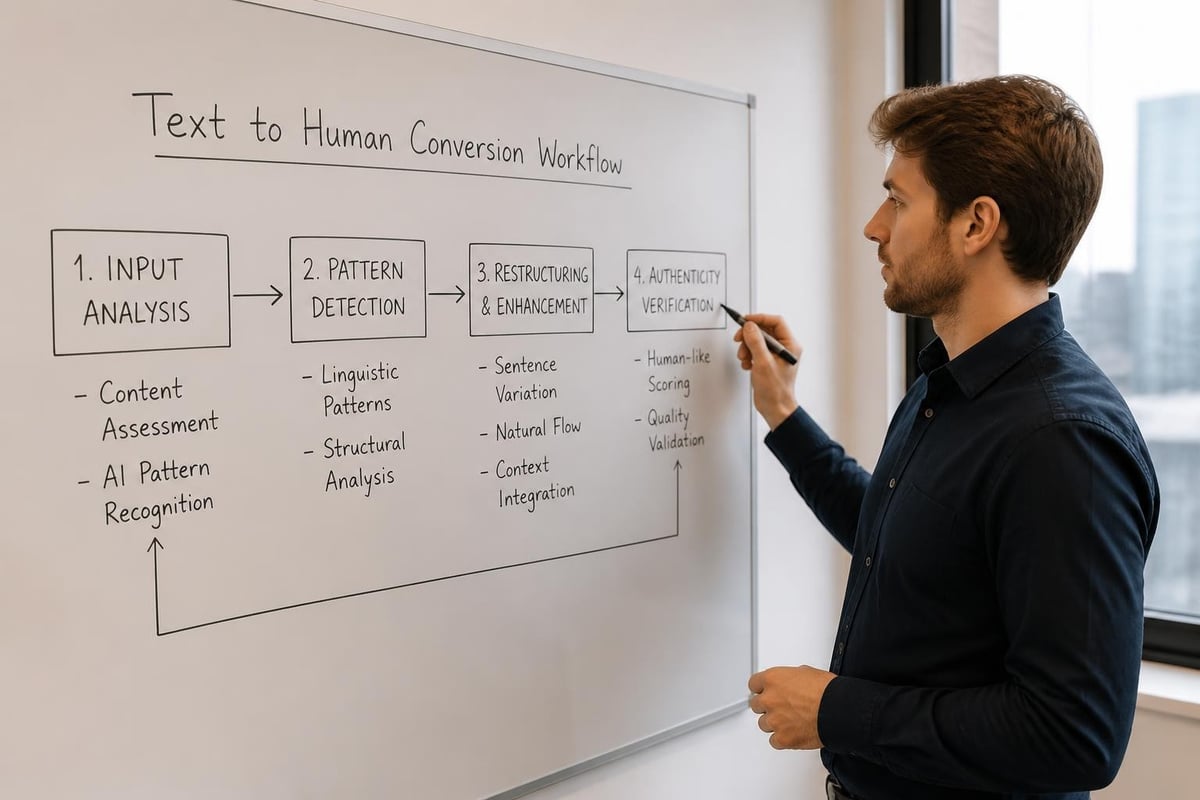
Text to human conversion represents a sophisticated process that analyzes AI-generated content and restructures it to mirror authentic human writing patterns. Unlike simple paraphrasing tools, genuine text to human technology rebuilds sentences from the ground up.
The transformation process involves multiple algorithmic stages working in concert. Advanced systems analyze input text for AI markers, then systematically introduce human writing characteristics including varied sentence structures, natural transitions, and authentic voice patterns.
Core Components of Effective Conversion
Professional text to human systems integrate several critical technologies:
- Pattern Recognition Algorithms that identify AI writing signatures
- Natural Language Processing that understands context and meaning
- Stylistic Variation Engines that introduce human-like inconsistencies
- Contextual Rewriting that preserves academic integrity
- Detection Bypass Verification that tests output against major AI detectors
Students seeking reliable text to human conversion should understand that not all tools deliver equal results. The effectiveness of AI humanizer tools varies dramatically based on underlying technology and update frequency.
The Student Perspective on AI Writing Challenges
College students face unprecedented pressure to submit original, authentic work while leveraging available technology for research and drafting. The disconnect between institutional policies and practical writing tools creates a gray area that many navigate with text to human solutions.
According to education technology analysis, AI humanizers have become common tools that students use to refine AI-assisted drafts into submission-ready papers. The motivation isn't necessarily academic dishonesty-many students use AI for brainstorming, outlining, and initial drafts before heavily revising content.
Real Scenarios Driving Text to Human Adoption
Students turn to text to human technology in specific, recurring situations:
- International students whose non-native English gets flagged as AI-generated
- Deadline pressure forcing quick AI-assisted drafts that need humanization
- False positive anxiety after legitimately written work triggers detection software
- Research synthesis where AI helps organize sources but output sounds robotic
- Writer's block recovery when AI jumpstarts ideas requiring natural refinement
Understanding how professors identify AI essays helps students appreciate why mere paraphrasing fails while comprehensive text to human conversion succeeds. Instructors recognize specific patterns including overly formal language, perfect grammar without natural errors, and suspiciously uniform paragraph structures.
Technical Mechanics Behind Conversion
The science of text to human transformation relies on sophisticated linguistic analysis and pattern manipulation. Effective systems don't simply swap synonyms-they fundamentally restructure how ideas are expressed while maintaining semantic integrity.
Modern text to human platforms analyze writing at multiple levels simultaneously. Morphological analysis examines word formation, syntactic analysis evaluates sentence structures, and semantic analysis ensures meaning preservation throughout transformation.
| Analysis Type | Purpose | Impact on Output |
|---|---|---|
| Lexical | Word choice variation | Natural vocabulary diversity |
| Syntactic | Sentence structure mixing | Reduced pattern predictability |
| Semantic | Meaning preservation | Content accuracy maintenance |
| Stylistic | Voice consistency | Authentic tone establishment |
| Coherence | Logical flow | Natural progression |
Research into human biases in detecting AI content reveals that perception matters as much as technical accuracy. Text to human systems must account for both algorithmic detection and human reader expectations.
Advanced Techniques for Natural Output
Professional text to human conversion employs several sophisticated techniques:
Burstiness Introduction: Human writers naturally vary sentence length dramatically-short, punchy statements followed by complex, meandering explanations. AI tends toward consistent medium-length sentences. Effective conversion actively disrupts this uniformity.
Perplexity Calibration: AI-generated text exhibits low perplexity, meaning word choices are highly predictable. Text to human systems intentionally increase perplexity through unexpected but appropriate word selections that human writers would naturally make.
Imperfection Integration: Counterintuitively, adding minor stylistic quirks-like occasional comma splices, varied punctuation spacing, or conversational asides-makes writing appear more authentically human. Perfect grammar can actually trigger suspicion.

Evaluating Text to Human Solutions
Not all text to human tools deliver equivalent results. Students must evaluate options based on specific criteria that determine whether converted content will pass institutional scrutiny.
The market offers numerous solutions ranging from basic paraphrasing to advanced humanization. Understanding differences helps students select appropriate tools for their academic needs and risk tolerance.
Critical Evaluation Criteria
When assessing text to human platforms, prioritize these factors:
- Detection bypass rate against major systems like Turnitin and GPTZero
- Content preservation ensuring ideas remain intact
- Natural voice maintenance matching your writing style
- Processing speed for deadline situations
- Cost efficiency for regular academic use
Students should also consider how different AI humanizers compare in real-world testing scenarios. Independent verification matters more than marketing claims.
Academic Integrity Considerations
The ethics of text to human technology generate legitimate debate within academic communities. Students must navigate complex questions about authorship, assistance boundaries, and institutional expectations.
Understanding where AI assistance crosses into academic dishonesty requires nuance. Using AI for brainstorming differs fundamentally from submitting unmodified AI output. Text to human tools occupy a middle ground-transforming AI-assisted drafts into personally authentic submissions.
Establishing Personal Guidelines
Responsible text to human usage involves establishing clear personal boundaries:
- Original thinking remains yours: Ideas, arguments, and analysis should originate from your understanding
- AI assists, doesn't replace: Use AI for drafting help, not complete assignment completion
- Significant transformation required: Text to human should be one step in extensive revision
- Voice authenticity matters: Final output should sound like your natural writing style
- Citation appropriateness: Credit sources regardless of how you discovered them
Many students discover that humanizing AI writing effectively requires understanding your own writing patterns and ensuring converted content matches your established voice.
Detection Technology Limitations
AI detection systems operate with inherent limitations that create false positive risks for legitimate student writing. Understanding these constraints helps contextualize why text to human technology has become necessary for many students.
Research examining whether people can distinguish AI from human text demonstrates that even trained individuals struggle with accuracy. Detection algorithms face similar challenges, leading to reliability concerns.
Common False Positive Triggers
Students using text to human solutions often respond to previous false positive experiences. Common triggers include:
- Formal academic language matching AI training corpus styles
- Well-researched content showing high topical coherence
- International student writing following learned English patterns
- Discipline-specific terminology appearing in AI datasets
- Carefully edited work lacking natural first-draft imperfections
When students experience false accusations despite honest work, text to human technology provides a defensive strategy-ensuring even legitimately written content avoids triggering overly sensitive detection algorithms.
Practical Implementation Strategies
Successfully implementing text to human conversion requires understanding both technical processes and strategic application. Students who master these approaches produce consistently natural, undetectable academic writing.
The transformation workflow should integrate seamlessly into existing writing processes. Rather than viewing text to human as a standalone solution, treat it as one component in comprehensive essay development.

Step-by-Step Conversion Workflow
Implement text to human technology effectively through this systematic approach:
Initial Drafting Phase: Use AI tools for research synthesis, outline development, and rough draft creation. Focus on getting ideas documented rather than perfect expression.
First Humanization Pass: Run AI-generated sections through text to human conversion. This establishes baseline natural language while preserving core ideas and structure.
Personal Revision Layer: Manually revise converted content, adding personal insights, refining arguments, and ensuring your authentic voice emerges. This step differentiates acceptable AI assistance from problematic over-reliance.
Voice Consistency Check: Compare converted sections against your previous writing. Adjust tone and writing style to match your established patterns and preferences.
Detection Verification: Test final content through multiple AI detection systems. This quality assurance step confirms successful text to human transformation before submission.
Advanced Customization Options
Sophisticated text to human platforms offer customization features that enhance output authenticity and personal alignment. Understanding these options helps students produce work that truly sounds like their own writing.
Customization extends beyond simple paraphrasing into voice matching, style calibration, and academic level adjustment. These features transform generic humanization into personalized conversion.
Key Customization Features
| Feature | Purpose | Student Benefit |
|---|---|---|
| Academic Level | Adjusts vocabulary complexity | Matches expected performance |
| Formality Slider | Controls tone casualness | Aligns with discipline norms |
| Voice Profile | Learns personal patterns | Ensures consistent style |
| Citation Style | Formats references | Maintains academic standards |
| Creativity Balance | Varies expression uniqueness | Avoids detection patterns |
Advanced users create writing profiles that text to human systems reference during conversion. This personalization ensures converted content matches individual writing fingerprints rather than generic humanization patterns.
Industry Innovation and Future Development
Text to human technology continues evolving rapidly as both AI generation and detection systems advance. Understanding development trajectories helps students anticipate capability changes and adapt strategies accordingly.
The technological arms race between AI content generation and detection drives constant innovation. Each detection algorithm improvement prompts corresponding advancement in text to human conversion techniques.
Emerging Capabilities
Current development focuses on several breakthrough areas:
Contextual Voice Matching: Next-generation systems analyze previous student submissions to establish authentic voice profiles, then ensure all converted content maintains consistent stylistic fingerprints.
Real-Time Detection Feedback: Advanced platforms integrate detection testing directly into conversion workflows, automatically adjusting output until detection bypass thresholds are met.
Semantic Preservation Verification: New algorithms ensure transformed text maintains not just surface meaning but argumentative nuance, evidence relationships, and analytical depth.
The evolution of AI voice technology reaching human-indistinguishable levels parallels written text to human advancement. Both domains demonstrate that authentic human mimicry has become technologically achievable.
Selecting the Right Solution for Academic Needs
Students face dozens of text to human options ranging from free basic tools to premium comprehensive platforms. Making informed selections requires matching tool capabilities to specific academic requirements and risk profiles.
The decision framework should account for assignment stakes, institutional detection sophistication, personal writing skill level, and budget constraints. Different scenarios justify different solution investments.
Decision Framework for Tool Selection
Consider these factors when evaluating text to human platforms:
- Assignment importance: High-stakes finals justify premium tools over casual homework
- Detection system sophistication: Research universities with advanced AI detection require robust humanization
- Deadline pressure: Time-critical situations need fast processing with reliable results
- Budget availability: Frequent users benefit from subscription models versus per-use pricing
- Technical comfort: Some platforms require more setup than others
For students serious about consistent, reliable results, services like GenZWrite offer comprehensive text to human conversion specifically designed for academic contexts. The platform transforms ChatGPT-generated essays into natural, submission-ready content that bypasses major detection systems including Turnitin.
Beyond Basic Humanization
Effective text to human implementation extends beyond simple conversion into comprehensive writing enhancement. Students who master these tools use them as learning instruments that improve their understanding of natural writing patterns.
The best text to human applications function as writing education tools-demonstrating how to vary sentence structure, choose unexpected vocabulary, and create authentic voice through example. Observing conversion outputs teaches valuable composition lessons.
Learning From Conversion Patterns
Students gain writing insights by analyzing how text to human systems transform AI output:
Structural Variation Examples: Notice how converted text breaks uniform paragraph lengths, mixes simple and complex sentences, and introduces natural rhythm variations.
Vocabulary Enhancement Techniques: Observe word choice replacements that maintain meaning while reducing predictability and increasing natural expression.
Transition Authenticity: Study how humanized content creates organic flow between ideas without relying on formulaic connecting phrases typical of AI writing.
Understanding why teachers can detect AI writing helps students appreciate the specific patterns that text to human conversion must address. This knowledge improves both tool usage and independent writing skills.
Common Mistakes and How to Avoid Them
Students new to text to human technology frequently make implementation errors that compromise results. Recognizing these pitfalls enables more effective, secure usage from the start.
The most common mistake involves treating text to human as a complete solution rather than one step in comprehensive essay development. Over-reliance without personal revision produces detectable patterns and undermines academic learning.
Critical Errors to Avoid
Skipping Personal Revision: Never submit converted content without adding personal touches, examples, and voice adjustments. Text to human provides a foundation requiring your finishing work.
Ignoring Consistency Verification: Ensure converted sections match your established writing style. Dramatic voice shifts within submissions raise instructor suspicion regardless of detection scores.
Overlooking Context Appropriateness: Text to human tools can't evaluate whether arguments suit assignment requirements. You must verify logical flow, evidence quality, and analytical depth.
Neglecting Detection Testing: Always run final drafts through multiple AI detectors before submission. This verification step catches potential issues while revision remains possible.
Forgetting Citation Integration: Humanized content still requires proper source attribution. Text to human conversion doesn't eliminate academic integrity responsibilities around citation and referencing.
Integration With Academic Success Strategies
Text to human technology works most effectively when integrated into broader academic success approaches. Students who combine humanization with strong research, critical thinking, and revision practices produce superior outcomes.
The tools should support, not replace, fundamental academic skills development. Using text to human to overcome writer's block or polish rough drafts differs fundamentally from outsourcing thinking to AI systems.
Holistic Academic Approach
Successful students incorporate text to human conversion within comprehensive strategies:
- Develop strong research foundations through library databases and scholarly sources
- Create detailed outlines reflecting personal analysis and argument structure
- Use AI for initial drafting to overcome blank page challenges
- Apply text to human conversion to establish natural expression
- Conduct multiple personal revision passes adding unique insights and voice
- Seek peer feedback on argument strength and clarity
- Perform final detection testing before submission
This integrated approach ensures text to human technology enhances rather than replaces genuine learning and skill development.
Understanding text to human technology and implementing it strategically helps students navigate modern academic writing challenges while maintaining authentic voice and academic integrity. The key lies in treating these tools as writing assistants that enhance personal work rather than replacements for genuine thinking and expression. When you're ready to transform AI-assisted drafts into naturally flowing, submission-ready essays that confidently pass any detection system, GenZWrite provides the reliable, student-focused text to human conversion that 100,000+ college students trust for undetectable results every time.

Rita Jamal
AI Content Specialist
Relateted Articles

Students Are Getting Flagged for AI… Even When They Didn’t Use It
Students are facing a new academic crisis: being accused of using AI when they actually wrote the work themselves. As AI detectors like Turnitin and GPTZero struggle with high false-positive rates, even the best students are being unfairly flagged. Learn why academic clarity triggers these algorithms, the bias against non-native speakers, and how to use an AI humanizer to protect your GPA and your reputation from flawed software.

GenZWrite
GenZWrite official
The Definitive Guide to AI Humanization in 2026: GenZWrite vs. the Top 6 Tools
Discover the best AI humanizers of 2026. We compare GenZWrite against Phrasly, Humbot, and StealthWriter, Quillbot based on structural variety, tone control, and bypass reliability. Learn why structural reconstruction—not just synonym swapping—is the key to undetectable, professional writing this year
GenZWrite
GenZWrite official

The Best AI Humanizer for Turnitin in 2026
Turnitin doesn’t just look for "AI words"—it tracks the statistical fingerprint of your writing. In 2026, simple synonym swaps no longer work. This guide reveals the data-driven way to humanize your essays, bypass "burstiness" checks, and protect your academic reputation with tools that actually work.
GenZWrite
GenZWrite official
Humanize & Detect AI
Transform robotic AI text into natural, engaging content that passes detection and ranks higher.