AI vs. Human Writing Quality: What Students Need to Know

Students rely on AI more than ever. Here’s how AI writing compares to human writing — and what schools actually care about.
In the span of just a couple of years, the landscape of academia has shifted permanently. The arrival of sophisticated Large Language Models (LLMs) has turned the traditional essay-writing process on its head. Today, students stand at a crossroads: on one side is the efficiency and speed of artificial intelligence; on the other is the nuance, critical thinking, and "soul" of human authorship.
As the lines between these two worlds blur, understanding the gap in quality is no longer just an academic curiosity—it is a survival skill. Whether you are looking to polish a rough draft or trying to understand why a professor flagged a perfectly factual paper, the difference between "generated" and "authored" content is everything.
The Rise of the Machine: Why AI is Tempting
It’s easy to see why AI has become the go-to "tutor" for millions of students. Tools like ChatGPT, Claude, and Gemini offer something humans rarely have: infinite patience and instant output. For a student juggling a part-time job, social obligations, and fifteen credits, the ability to generate a structured outline in seconds is intoxicating.
However, "perfect" grammar does not equate to "high quality" writing. In fact, the very "perfection" of AI is often its greatest weakness in an academic setting. AI-generated text often suffers from homogenization. Because these models are trained on averages, their output tends to be the "most likely" sequence of words, leading to repetitive transitions and a lack of specific, localized examples.
Bridging the Gap: The Need for Human Nuance
In the current academic climate, submission of raw AI output is a recipe for disaster. Not only do AI detectors look for these patterns, but experienced professors can spot the clinical "vibe" of AI from a mile away. This is where the modern student needs to step in as an editor.
If you find yourself with a draft that feels robotic or overly formal, you can use specialized platforms like GenZWrite to Rewrite my essays with a focus on flow and academic tone. By refining the AI’s base output, you ensure that the final product retains the structural benefits of technology while adopting the stylistic flair of a human scholar.
Why You Must Humanize AI Text
To truly succeed, a student must inject characteristics that machines simply cannot replicate: empathy, personal anecdote, and unconventional logic. Human writing is messy; we use fragments for emphasis, make cultural references that aren’t in a training manual, and connect two seemingly unrelated ideas through a "spark" of intuition.
If you are using AI to assist with your research or drafting, you must take the extra step to Humanize ai text through GenZWrite. This process strips away the "robotic" sheen and replaces it with the intellectual DNA that professors look for—critical thinking and a unique authorial voice.
The Anatomy of Quality: AI vs. Human
To understand the difference, let’s look at the pillars of high-quality academic writing:
1. Critical Thinking and Original Argument
AI is a "stochastic parrot." It predicts the next word based on probability; it doesn’t actually understand the argument it’s making.
- The AI Flaw: It often produces "hallucinations"—confidently stating facts that are entirely made up.
- The Human Edge: A human student can synthesize their personal experience with a lecture they heard three weeks ago. This "lateral thinking" is the hallmark of high-quality work.
2. Emotional Intelligence (EQ)
Writing is a form of communication between two humans. Whether you’re writing about history or ethics, there is an emotional component to the narrative.
- The AI Flaw: AI cannot feel. It can simulate empathy, but it often comes across as performative or "cheesy."
- The Human Edge: Humans understand nuance, irony, and sarcasm. We know when to be somber and when to be provocative.
How to Use AI Without Losing Your Grade
The goal for the modern student shouldn't be to avoid AI entirely—that would be like avoiding a calculator in math class. Instead, the goal is to use it as a scaffold, not the building itself.
- Brainstorm with AI: Use it to generate five different angles for a thesis statement.
- Outline with Intent: Let the machine suggest a logical flow, then move the sections around to fit your specific argument.
- Fact-Check Everything: Never assume an AI-generated date, quote, or citation is real.
- Final Polish: Use an ai humanizer strategy to break up the "robotic" flow and ensure the rhythm of the sentences feels natural and engaging.
The Future: The "Cyborg" Approach
We are entering an era of "Cyborg Writing," where the most successful students will be those who can collaborate with AI while maintaining their human authority. The quality of human writing is defined by its imperfections and its depth. The quality of AI writing is defined by its efficiency and its breadth.
The "A+" student of the future will be the one who knows how to bridge that gap—taking the raw data of a machine and performing the necessary steps to refine it until it resonates with a human audience.
Conclusion
As AI continues to evolve, the "bar" for what constitutes good writing is actually rising. Because anyone can generate a "decent" essay in ten seconds, "decent" is no longer enough to impress. To stand out, students must double down on what makes them human: their unique perspectives and their critical skepticism.
Don't let the machine speak for you. Use it to find your voice, but always ensure that at the heart of every page, there is a human mind at work. In the battle of AI vs. Human writing quality, the winner is always the student who knows how to use both effectively.

GenZWrite
GenZWrite official
Relateted Articles
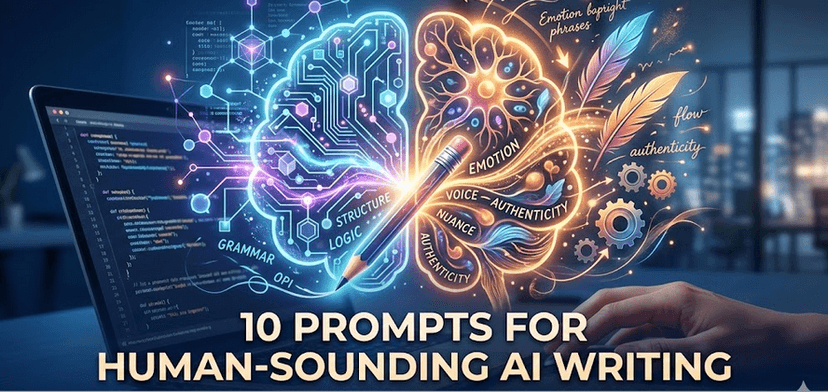
10 Prompts for Human-Sounding AI Writing (And How to Automate It)
AI writing often feels stiff and soul-less. Discover 10 powerful prompts to inject personality into your drafts and see how GenZWrite makes it even easier to bypass detectors.
GenZWrite
GenZWrite official

Why AI Writing Gets Flagged Even When It’s Human and How to Fix It
AI detectors often flag human writing due to patterns, not truth. This guide shows essay writers how to fix structure, improve flow, and use AI humanizers effectively.
GenZWrite
GenZWrite official
Humanize & Detect AI
Transform robotic AI text into natural, engaging content that passes detection and ranks higher.