Bypass ChatGPT Detectors: Smart Essay Writing Strategies for the Modern Student

Learn how to use AI tools like ChatGPT responsibly in academic writing. This guide explores how AI detectors work, why they matter, and practical strategies to write authentic, human-sounding essays without risking integrity or originality.
In the evolving world of academic writing, one phrase has started to dominate conversations: “bypass ChatGPT detectors”. If you’re a student using AI tools like ChatGPT to assist your essay writing, you may face the daunting task of making your work pass through software designed specifically to detect AI-generated text. While bypassing detection entirely isn’t a recommended shortcut, there are legitimate strategies you can use to write smarter essays and avoid detection risks.
What are AI detectors and why they matter
AI detection tools are designed to pick up signs that a text was generated (or heavily assisted) by AI. For example, one tool claims a 99% accuracy rate in differentiating AI-versus-human text. GPTZero These detectors scan for features like low sentence-variation, over-regular syntax, or linguistic patterns typical of large language models. In academic environments, such tools are used by institutions like Turnitin to uphold integrity. Wikipedia
If your essay triggers a detection alert, you may face academic consequences or need to rewrite. So the goal isn’t necessarily cheating the system, but rather writing in a way that genuinely reflects your own work and voice.
Strategies to write essays that naturally bypass detection
Here are actionable strategies:
- Use AI for outline/bullets, not final text: Let ChatGPT generate ideas or an outline. Then you write the actual essay with your phrasing and flow.
- Blend your own writing with AI assist: If you use AI for a paragraph, follow it up with your thoughts, your case studies, or your reflections. Detector systems struggle with hybrid text when your own voice is layered in.
- Avoid over-polished, “textbook” phrasing: AI often writes in formal, flawless style. Inject minor human-style elements: colloquial linkers (“On the flip side”, “What’s interesting is”), short sentences, or rhetorical questions.
- Vary sentence length and complexity: Humans naturally mix short and long sentences. A text that is uniformly well-structured may raise flags.
- Include specific personal references: For student essays, mention your class, your experiment, your schedule, your observations. The more specific to your life, the more human.
- Proofread manually (don’t rely only on AI grammar checkers): If you let an AI grammar checker polish everything, you might inadvertently reduce the “human footprint”. Your manual tweaks matter.
- Run a detector test BEFORE submission: You can test your draft against free detectors to spot possible trigger zones, then rewrite accordingly.
- Understand the “human write guarantee” mindset: Your goal should be: “This is my writing”. If you cannot confidently say that every line sounds like you, revise more.
Ethical considerations and student life context
While bypassing detectors may sound like subversion, the real issue is authenticity. If you rely entirely on AI and submit it as your own, you risk learning less—even if you’re not caught. Student life is about growth, not shortcuts. At the same time, AI is here to stay, so smart use is part of the modern toolkit. Tools that humanize AI text are emerging to help students preserve voice and authenticity. Decopy AI+1
Pitfalls to avoid
- Don’t copy-paste large chunks of AI-generated text and hope it passes. Detectors are getting better, and institutions unify policies.
- Don’t rely on being undetected as the only motivation. Your writing still needs to make sense, reflect your learning, and communicate clearly.
- Be aware of plagiarism and citation norms. Even if something is human-written, you must still cite sources. Good writing is not only undetected but also honest.
The phrase “bypass ChatGPT detectors” is less about evading and more about writing with integrity in an AI-assisted world. Use AI smartly, preserve your voice, embed personal student-life context, and run self-checks. Do all that, and your essays won’t just bypass detectors—they’ll stand out as you authored them. A real “human write guarantee”.

Rita Jamal
AI Content Specialist
Relateted Articles

AI in Academia: How to Humanize Student Writing Without Losing Your Voice
Discover how students can use AI in academic writing while preserving originality, tone, and personal voice—without triggering AI detectors
Rita Jamal
AI Content Specialist

Free vs Paid AI Humanizers: What Most Tests Don’t Tell
Not all AI humanizers are equal. See why free tools fail on essays and which paid options produce safer, more natural writing.
Rita Jamal
AI Content Specialist
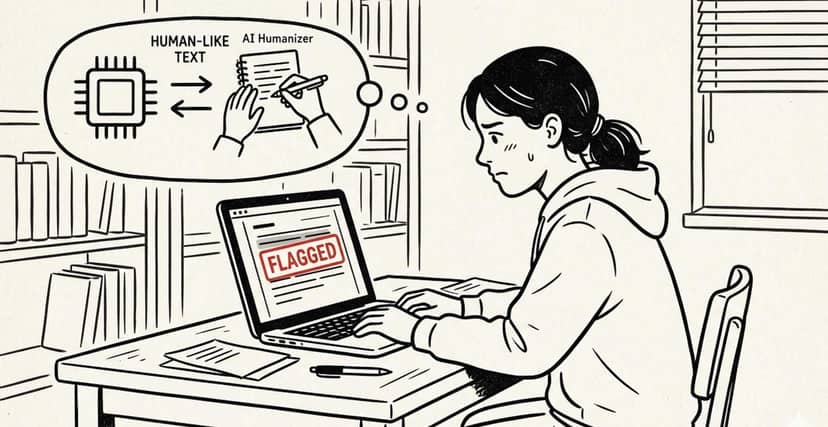
Why Students Are Searching for an AI Humanizer More Than Ever During Finals Season
Finals stress now comes with a new threat: AI detectors flagging honest student essays. With false positives hitting non-native speakers hardest and real academic consequences on the line, students are turning to AI humanizers to protect their work. Here is what they actually need from these tools in 2026.
Rita Jamal
AI Content Specialist
Humanize & Detect AI
Transform robotic AI text into natural, engaging content that passes detection and ranks higher.