Flagxiety Is Real! The Only Fix Is an AI Humanizer That Actually Understands Students
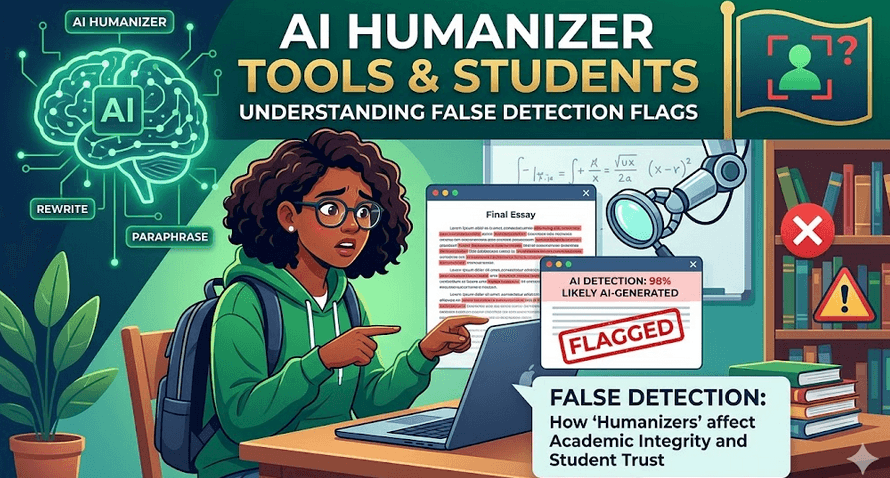
AI detectors are flagging innocent students and the fear has a name: flagxiety. Here's why unreliable detection tools are failing Gen Z, and how the right AI humanizer protects your voice and your academic record.
There is a new kind of anxiety spreading across college campuses in 2026, and it has a name: flagxiety.
It is the low-grade dread that settles in the moment you hit "submit" on an essay, the gnawing thought that Turnitin or GPTZero might flag your completely human-written work as AI-generated. According to a 2026 Inside Higher Ed survey, 75% of students now report stress related to AI detection, and more than half specifically fear being falsely accused of using AI. For international and ESL students, that anxiety is roughly twice as intense.
This is not paranoia. It is a rational response to a broken system and understanding why it is broken is the first step to protecting yourself.
The Detector Problem Nobody Wants to Talk About
Let's be honest about what AI detectors actually do. Tools like Turnitin, GPTZero, and ZeroGPT do not know whether you used AI. They measure statistical patterns in your writing perplexity, burstiness, predictability and compare them to what AI-generated text tends to look like. When your writing happens to share those patterns, the tool flags it. Full stop.
The false positive rates are staggering:
- Turnitin admits to a 4% false positive rate at the sentence level. Sounds small? At a single large university scanning 2.2 million assignments per year, that is up to 88,000 innocent students wrongly accused.
- GPTZero has an independent false positive rate of approximately 22% on certain text types.
- ZeroGPT clocks in at 16.9% in independent testing.
- A landmark Stanford University study found that AI detectors flagged 61% of essays written by non-native English speakers as AI-generated simply because formal, structured writing resembles the patterns these models were trained on.
A professor at Cal State Monterey Bay put it plainly: "It's almost like the better the writer you are, the more AI thinks you're AI."
This is the environment today's students are writing in. And yet, the most common advice they receive is either "just don't use AI" or "just write naturally." Neither response addresses the core problem, which is that the tools doing the judging are deeply unreliable.
Why Students Are Turning to AI Humanizers and Why That Gets Misunderstood
Here is where the conversation gets complicated. When students hear about an AI humanizer, the assumption is that they are trying to cheat. But Reddit threads, academic forums, and real student testimonials tell a far more nuanced story.
Yes, some students use humanizers to disguise fully AI-written essays. But a significant, often overlooked group uses them for something entirely different: to protect their own authentic writing from being falsely accused.
From r/college to r/ChatGPT, the threads are filled with stories like this one, from a Reddit user who described spending four hours making an essay "undetectable" after getting flagged even though they had written it themselves. Or the University at Buffalo student in May 2025 whose hand-written final papers were flagged by Turnitin. Twenty percent of her classmates were flagged too. Her graduation was briefly at risk.
These are not cheating stories. These are academic integrity horror stories about tools that punish students for writing too well, too formally, or too fluently in a second language.
An AI humanizer, used responsibly, does not make you a cheater. It makes your authentic voice harder to misclassify. The distinction matters enormously both ethically and practically.
The Part Most Humanizers Miss: Citations
Here is the gap that the AI humanizer market has almost entirely ignored: citations.
When a student uses AI assistance in their research or writing process even for brainstorming, outlining, or polishing most academic institutions now require some form of disclosure. APA 7th edition, MLA 9th edition, and Chicago all have updated their guidance to address AI use. Failing to cite AI assistance, even when the writing itself is original, can be treated as an integrity violation.
Most humanizers on the market today only rewrite your text. They return content that sounds more human, but they do nothing about the citation layer. That leaves students in a strange position: they have humanized their writing to avoid false AI flags, but they have not disclosed or cited the AI tools that helped them along the way. Now they are actually in violation of policy even if they started with honest intentions.
This is the problem that a genuinely student-focused tool needs to solve. The ability to humanize AI text should come paired with citation-awareness a system that helps you acknowledge AI assistance in the format your institution requires, so you are protected on both ends.
GenZWrite was built with exactly this in mind. The humanizer does not just rewrite your content to sound more natural. It supports proper AI citation formatting across major academic style guides, so your writing is both authentic and academically compliant. That is not a feature most tools think to include. For Gen Z students navigating a landscape where the rules are changing every semester, it is not optional.
How to Use an AI Humanizer Without Compromising Your Integrity
If you are going to use an AI humanizer and the research suggests more and more students will here is how to do it in a way that protects you academically and ethically.
1. Use AI as a tool, not a ghostwriter.
Use AI for brainstorming, outlining, or clearing a first-draft block. The ideas, arguments, and analysis should be yours. Humanizing a draft that started from your own thinking is very different from submitting fully generated content.
2. Always cite AI assistance.
Check your institution's current policy. Many now require a statement like: "This essay was drafted with the assistance of [AI tool]. All final arguments and edits are the author's own." Formats vary by style guide. APA, MLA, and Chicago all handle this differently. Use a tool that handles that formatting for you.
3. Run your own work through a detector before submitting.
This is a practical move that more students are adopting. If your authentic writing is triggering flags, you can adjust your language, add more personal voice, or use an AI humanizer to reduce the statistical signature all while keeping the core content yours.
4. Keep your drafts and writing history.
Google Docs, Notion, even screenshots of your outline notes these create a paper trail that can defend you if your work is questioned. Several universities have reversed false-positive rulings because students came prepared with evidence.
5. Know your rights.
Turnitin itself states that its tool should never be "the sole basis for deciding whether a student cheated." GPTZero carries the same disclaimer. If you are accused, you have the right to appeal, and detection scores alone are not proof of misconduct.
The Bigger Picture: Writing Should Feel Safe Again
What flagxiety has exposed is a fundamental mismatch between how academic institutions are trying to enforce integrity and how writing actually works in 2026. Students use Grammarly. They use dictation tools. They ask ChatGPT to explain a concept so they can understand it well enough to explain it themselves. They are not cheating they are writing in the tools available to their generation.
The answer is not to strip away those tools. It is to build better ones tools that help students write more authentically, cite more responsibly, and navigate a system that was not designed with them in mind.
An AI humanizer for students should not just be a bypass mechanism. It should be a writing partner that respects academic integrity as much as it respects your voice. That means humanizing your text and helping you document your process honestly.
Flagxiety will not disappear until detectors improve, institutions get clearer, and the tools students use actually catch up to the moment. Until then, the best thing you can do is write confidently, cite carefully, and choose tools that have your back on both counts.
GenZWrite is an AI writing platform built for students combining AI humanization with citation-friendly tools that keep your work authentic, your citations correct, and your academic record clean.

Rita Jamal
AI Content Specialist
Relateted Articles

AI in Academia: How to Humanize Student Writing Without Losing Your Voice
Discover how students can use AI in academic writing while preserving originality, tone, and personal voice—without triggering AI detectors
Rita Jamal
AI Content Specialist

Bypass ChatGPT Detectors: Smart Essay Writing Strategies for the Modern Student
Learn how to use AI tools like ChatGPT responsibly in academic writing. This guide explores how AI detectors work, why they matter, and practical strategies to write authentic, human-sounding essays without risking integrity or originality.
Rita Jamal
AI Content Specialist

Free vs Paid AI Humanizers: What Most Tests Don’t Tell
Not all AI humanizers are equal. See why free tools fail on essays and which paid options produce safer, more natural writing.
Rita Jamal
AI Content Specialist
Humanize & Detect AI
Transform robotic AI text into natural, engaging content that passes detection and ranks higher.